




Before starting Paramark, I worked as an aeronautical engineer in aircraft maintenance and systems design. In aviation, an aircraft going down isn’t just an inconvenience – it’s a catastrophic outcome that must be prevented through risk management.
Most website hosting and maintenance is not managed with that level of rigour. It’s often reactive: something breaks, and then it’s fixed. A plugin vulnerability leads to the website being hacked, and a cybersecurity company is called in. A backup is created, but it’s on the website server.
This article explains how we apply aviation safety principles to WordPress hosting and maintenance – and why that approach results in websites that are more reliable, more secure, and better protected against costly disruption.
Aircraft Crashes Are Prevented By Planning For Failure
An aeroplane’s systems are not maintained on the assumption that everything will probably be fine. They are maintained on the assumption that if a system can fail, it eventually will. The role of engineering and maintenance is to manage that risk to avoid an aircraft crash.

For most businesses, a website is not just a digital brochure. It generates enquiries, supports advertising campaigns, stores client information and represents the brand at all hours. If it goes down, loads incorrectly or becomes compromised, the impact is commercial. You might lose customers, suffer reputational damage or disrupt your marketing campaign.
Yet most WordPress websites are maintained reactively (if at all). Updates are done occasionally. Backups exist, but they’re all on the website server. Security plugins are disabled because they conflict with a plugin. The site works until the day it doesn’t.
Here’s an important question: have you or your hosting provider considered the various ways your website could fail and implemented a risk management strategy, or are you just praying it won’t happen?
In aviation, failure is not treated as an inconvenience. It is treated as a risk that must be managed in advance. The same mindset produces more reliable, more secure websites, and that is the foundation of our approach to WordPress hosting and maintenance.
The Swiss Cheese Model
In aviation safety, there is a concept known as the Swiss Cheese Model. The idea is simple. Major failures rarely happen because of one single catastrophic mistake. They happen when multiple small failures line up at the same time.
Each layer of protection is like a slice of Swiss cheese. Every slice has small holes, but if you stack enough slices together, the holes do not align. Risk is reduced because a single failure cannot pass straight through the system.
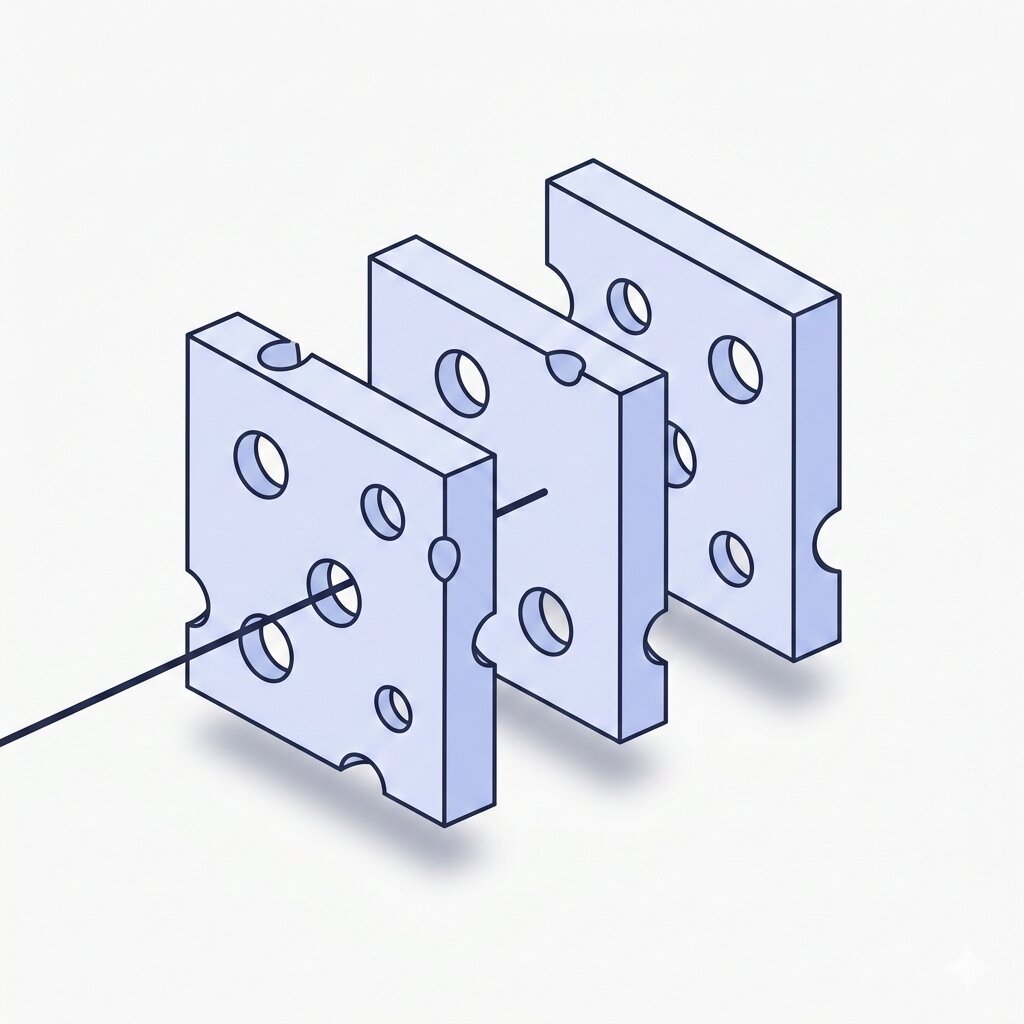
The same principle applies to WordPress websites. A server issue on its own may not destroy a site. An outdated plugin on its own may not cause a breach. A weak password on its own may not lead to compromise. But if you combine outdated plugins from unreliable developers, no security software, poor access management and low-quality hosting, the risk of getting hacked is almost certain.
When I review websites that have been hacked, it’s rarely one thing that’s gone wrong. It’s a sequence of decisions or failures that have resulted in the website suffering a security breach.
The practical takeaway for you is this: relying on one safeguard is not a strategy. True reliability comes from layering protections so that if one system fails, another one prevents the issue from escalating.
Redundancy
Critical systems in aeroplanes are not designed to rely on a single point of failure. Most aeroplanes have independent hydraulic systems that control the rudder, elevators, and ailerons, which are used to steer the aircraft. If one hydraulic system fails, another can still operate the controls. The objective is not to assume perfection. It is to plan for the possibility thatfailure of one system may occur.
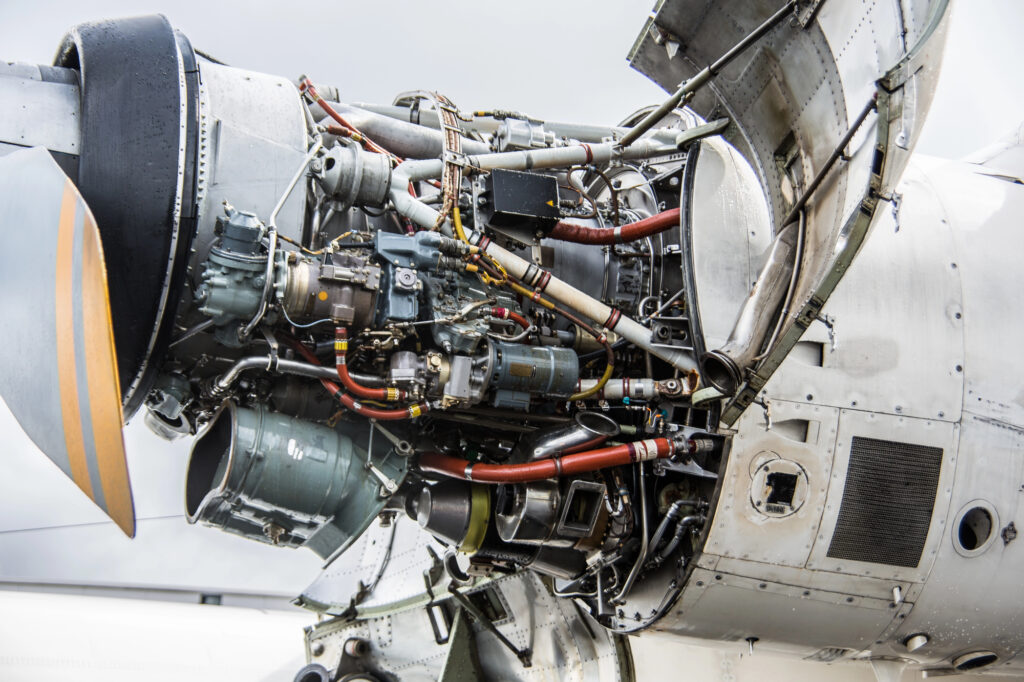
The same principle applies to WordPress hosting. If your website relies on a single backup system, you are relying on that single layer to always work. But what happens if your hosting provider’s server fails, or they go out of business, or your account is suspended? Those backups might not be there when you need them.
At Paramark, we maintain multiple backup sources for the websites we host. There are server-level backups, as well as backups stored in off-site locations. If one source is unavailable, another remains accessible. We have tested the restoration process itself so that if a problem occurs, the website can be restored.
If your website presents your business, supports advertising campaigns, and generates enquiries, then downtime affects revenue, campaign performance and customer confidence. Multiple backups to separate locations reduce the risk that your website will be permanently lost if something goes wrong.
Eliminating Risk Where Possible
Here is what matters when you think about website security. Not all risk controls are equal.
In aviation, risks are managed using a hierarchy. The most effective control is elimination. If a risk can be removed entirely, that is always better than trying to reduce or manage it later.
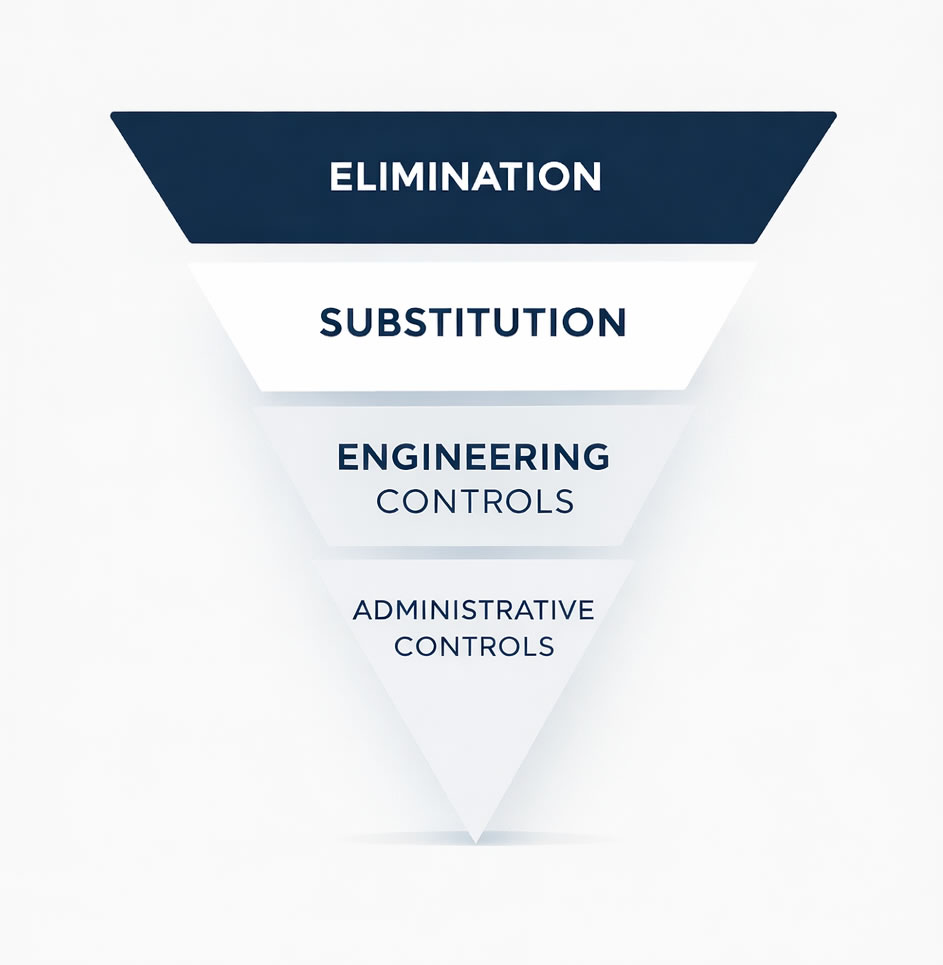
The same principle applies to your website. Instead of asking how to secure a potential vulnerability, it is worth asking whether that vulnerability needs to exist at all.
A practical example is the storage of enquiry forms. Many WordPress websites automatically store submissions inside the site database. That may feel convenient, but it also means personal information remains on the website. If that data does not need to be stored, removing it reduces your exposure entirely. In many cases, forms can be configured to deliver information where it needs to go without being retained long-term.
If a risk cannot be eliminated, the next step is substitution. With WordPress, plugins are a good example. You cannot eliminate plugins entirely because they provide essential functionality such as forms, security, performance optimisation and design control. However, every plugin you install increases the surface area for potential failure or security vulnerability.
Substitution means replacing higher-risk options with lower-risk alternatives. Instead of using discounted lifetime deal plugins from unknown developers, we choose widely adopted, actively maintained plugins from reputable teams with a track record of regular updates and security patches.
If a risk cannot be eliminated or substituted, the next step is engineering controls. These are protections built into the system itself.
Traditional hosting often places multiple websites in the same environment. If one site is compromised, others in that account can be exposed. At Paramark, we use Kinsta for our website hosting. Kinsta is one of the few WordPress hosting providers that gives you true isolation between websites – no shared resources or storage between websites. Each website operates separately, so a problem on one site does not affect another.
Administrative controls still play a role. Manual website checks, initial website configuration procedures, and yearly PHP updates all reduce exposure. However, these rely on consistent execution. Higher-level controls reduce dependence on human behaviour alone.
The goal is not zero risk. Our goal is to achieve structured risk reduction that protects stability, security, and business continuity.
Designing for Maintainability
Aircraft systems are designed not just to function, but to be maintained. Most of an aeroplane’s lifetime cost is in ongoing servicing, inspection and parts replacement. If it cannot be maintained properly, reliability suffers over time.
Websites are no different. A site that looks good at launch can become unstable if it is built with short-term thinking. Excessive custom code, unsupported plugins or one-off design workarounds often create problems later when updates are required.
At Paramark, we design websites with long-term maintainability in mind. That means using reputable, actively supported plugins, avoiding edits to core theme or plugin files, and managing any custom code in a controlled way. We also use templates for repeatable content, so future updates do not require rebuilding layouts from scratch. It might be more costly at the start, but it saves far more expensive fixes and headaches in the long run.
Maintainability reduces future risk. When a website is built properly, updates are smoother, compatibility issues are less common and ongoing changes can be made without destabilising the system.
Vendor Quality Assurance
Airlines don’t just purchase spares from unknown suppliers and hope for the best. Every part must come from an approved vendor with traceability and quality control. In the long term, the reliability of an aircraft depends on the reliability of suppliers.
WordPress plugins work the same way. Every plugin added to a website introduces code written and maintained by someone else. That code can affect security, performance and stability.
Not all plugins are developed to the same standard. Some are actively maintained by established teams with regular updates and a good security track record. Others are low-cost or lifetime deal products with limited ongoing support and unclear development practices.
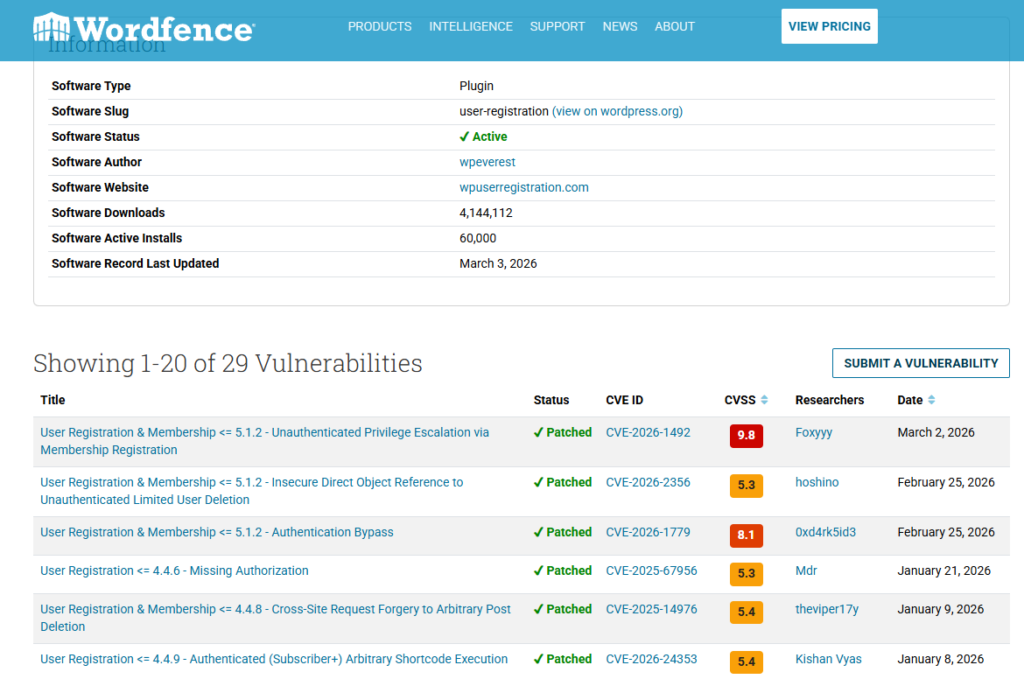
At Paramark, we treat plugin selection as a quality assurance decision. We look at update frequency, developer reputation, vulnerability history and overall adoption before using a plugin on a client website. Where appropriate, we use paid plugins with ongoing licensing rather than one-off purchases that may not be supported long term.
The quality of your website depends on the quality of the vendors behind it. Careful selection reduces the likelihood of security vulnerabilities, compatibility conflicts, and abandoned software becoming future liabilities.
Why We Don’t Rely on One Person
Work on an aeroplane is rarely signed off by the same person who performed it. Independent inspections are built into the process because even experienced technicians can make mistakes. A second set of eyes reduces the chance that an issue goes unnoticed.

The same principle applies to website development and maintenance. If one person builds, updates and reviews a website without oversight, errors can slip through. Those errors may not be obvious immediately, but they can affect functionality or security.
At Paramark, we separate responsibilities: we’ll have someone independently review the development work before it goes to the client, same with the content. In addition, automated systems independently monitor layout changes and uptime. This reduces the risk of a single point of failure, whether technical or human.
Independent checks reduce reliance on one individual and increase overall reliability. When processes include review and verification, problems are more likely to be identified early rather than discovered by your customers.
Detecting Issues Before Clients Do
Many businesses only discover a website problem when a customer brings it up. By that stage, the issue has already affected enquiries, advertising performance and brand perception.
We don’t wait around for our clients to tell us there’s a problem with their website. We perform proactive layout monitoring and uptime checks to ensure our clients’ websites are always up and running. If we detect a problem, we fix it – in most cases before a client even notices.
We use server-level uptime monitoring, which scans your website every 3 minutes to confirm functionality. We also run automated daily layout checks on key pages. This allows us to detect visual or functional changes that standard uptime monitors would miss. There is an important distinction here. A website can be technically online but display incorrectly. Most basic hosting services only monitor whether the site responds (if that). They do not check whether it looks or functions as intended.
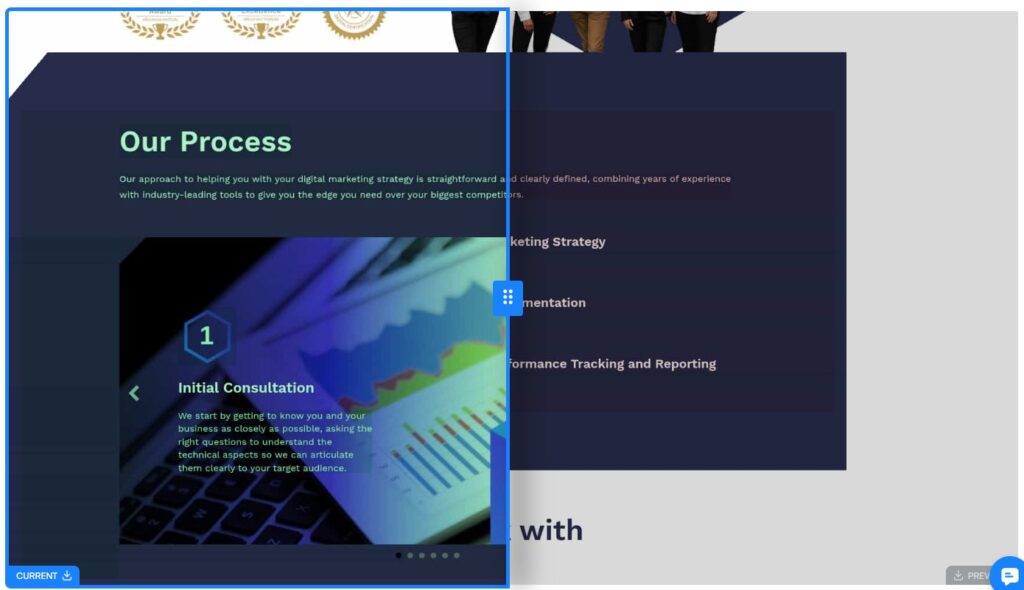
Proactive monitoring reduces the likelihood that your customers are the first to notice a problem. It shifts website maintenance from reactive troubleshooting to early detection and controlled resolution.
Speed & Performance
Website performance is not just a technical metric. It affects user experience, conversion rates and search visibility. A slow website can reduce the effectiveness of your advertising spend and increase bounce rates, particularly on mobile devices.
Performance should be engineered, not added as an afterthought. That starts with how the website is built. At Paramark, we select plugins and themes carefully to avoid unnecessary bloat. We avoid stacking multiple tools that duplicate functionality, which can increase your website’s load time.
Image handling is another important factor. Instead of uploading oversized files and relying on the browser to cope, we optimise image formats and dimensions during design. This reduces file size without compromising visual quality.
Caching and network-level optimisation also play a role. With appropriate server-level caching and services such as Cloudflare filtering and distributing traffic, resources are delivered more efficiently and load times improve.
Performance is the result of deliberate design decisions. When speed is engineered into the website from the beginning, the outcome is a faster, more responsive experience that supports your marketing efforts rather than limiting them.
Engineering-Level Reliability for Your Business Website
Your website may not operate in controlled airspace, but it does operate in a competitive market. It supports your marketing, represents your brand and often serves as the first point of contact for potential customers. When it fails, the impact is commercial.
Throughout this article, we have looked at how aviation principles apply to WordPress hosting and maintenance. Layered protection reduces the likelihood that small issues will align. Redundancy protects continuity. Risk management prioritises elimination and structural controls over reactive fixes. Maintainability and vendor selection influence long-term stability. Independent checks and proactive monitoring reduce the chance that problems go unnoticed. Performance engineering supports conversion and visibility.
None of this is accidental. It is the result of deliberate systems and structured processes.
Reliable websites are engineered, not improvised. If your website is important to your business, it’s important to us, and it’s worth asking whether it is being maintained adequately.
If you would like your website hosted and maintained using this structured, engineering-led approach, contact Paramark to learn more about our WordPress hosting and maintenance services.